
In today’s fast-paced world, stress can feel like a constant companion. If you’ve been looking for a way to quiet your mind, reduce anxiety, and reclaim your inner peace, you’ve likely stumbled upon meditation.
But here’s the catch: meditation isn’t a one-size-fits-all practice. What brings deep relaxation to one person might leave another feeling restless.
Understanding the different kinds of meditation and how they work can help you find the exact style your mind and body need to unwind. Let’s dive into the most popular types of meditation and explore the science behind how they induce deep relaxation.
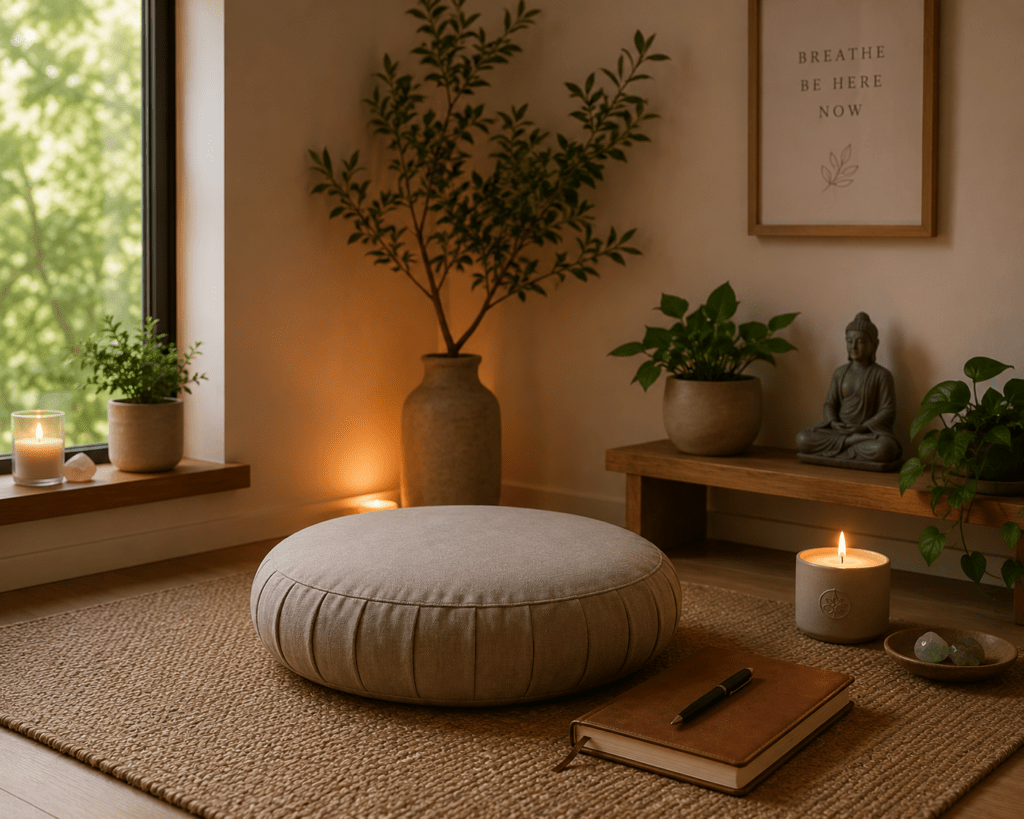
The Science of Calm: How Meditation Helps You Relax
Before exploring the types, it helps to understand why sitting in silence changes your biology.
When you experience chronic stress, your nervous system is stuck in a “fight-or-flight” state driven by the sympathetic nervous system. Meditation acts as a biological brake pedal. It activates the parasympathetic nervous system, often called the “rest-and-digest” system.
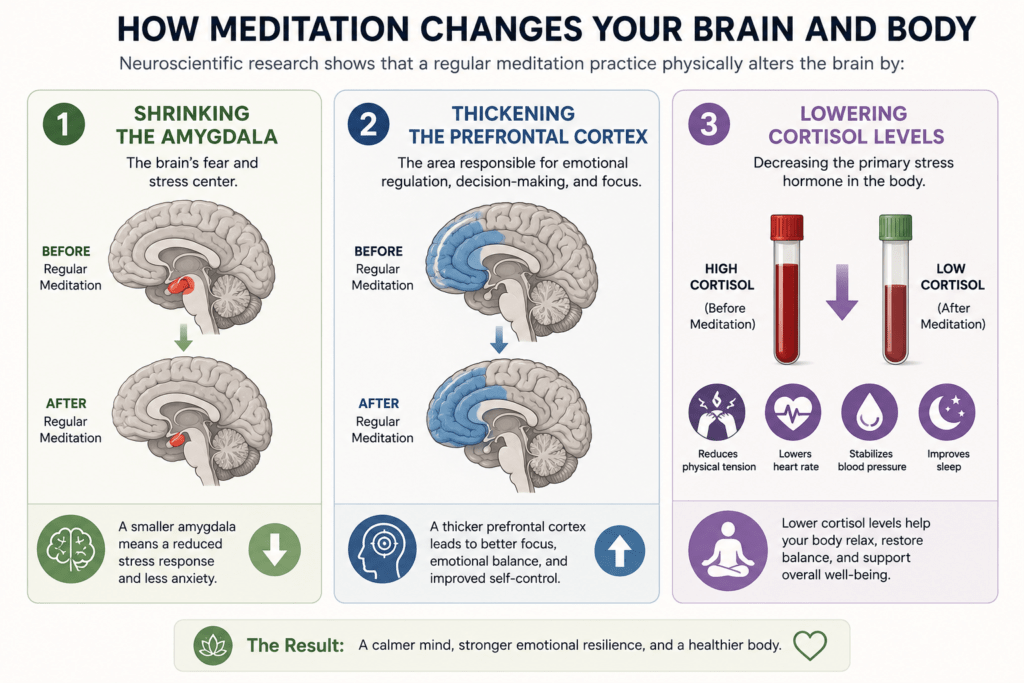
According to neuroscientific research, a regular meditation practice physically alters the brain by:
- Shrinking the amygdala: The brain’s fear and stress center.
- Thickening the prefrontal cortex: The area responsible for emotional regulation, decision-making, and focus.
- Lowering cortisol levels: Decreasing the primary stress hormone to reduce physical tension, lower your heart rate, and stabilize blood pressure.
5 Popular Kinds of Meditation for Relaxation
1. Mindfulness Meditation
Originating from Buddhist teachings, mindfulness is the most widely practiced form of meditation in the West.
- How it works: You pay close attention to your thoughts, sounds, and sensations as they pass through your mind without judging them. If your mind wanders to your to-do list, you gently acknowledge the thought and guide your focus back to the present moment.
- How it helps you relax: By teaching you to observe your stressful thoughts rather than getting tangled up in them, mindfulness breaks the cycle of anxious overthinking.
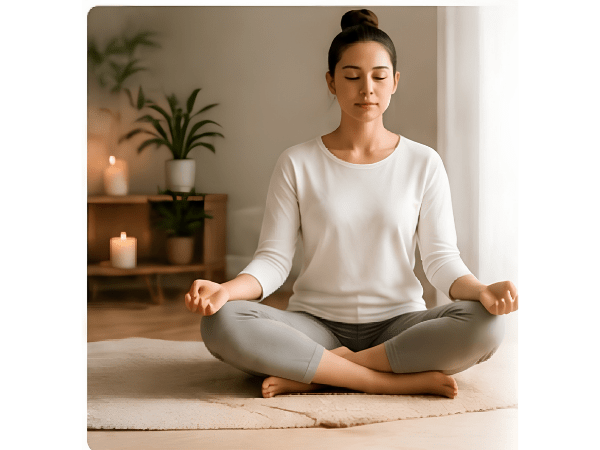
Step-by-step Procedure for Meditation

1. Find a Quiet Space
Choose a calm,comfortable place where you won’t be disturbed.
2. Sit Comfortably
Sit with your back straight but relaxed. You can sit on a chair, cushion, or the floor. Rest your hands on your lap.

3. Close Your Eyes or Soften Your Gaze
Gently close your eyes or look down softly.

4. Focus on Your Breath
Bring your attention to your natural breath—feel the air entering and leaving your body.

5. Notice Thoughts and Sensations
Notice any thoughts, sounds, or body sensations as they arise. Don’t judge them-just observe.

6. Gently Return to the Present
If your mind wanders,gently acknowledge it and bring your focus back to your breath.
7. Continue for a Few Minutes
Start with 5-10 minutes. Gradually increase the time as you feel comfortable.

8. Close the Session Mindfully
Take a deep breath,feel your body,and slowly open your eyes. Carry this calm awareness into your day.
2. Guided Imagery (Visualization)
If you struggle with silence or find your mind racing when you close your eyes, visualization gives your brain a calming focal point.
- How it works: You listen to a guide or use your own imagination to picture a serene, peaceful scene—like a sun-drenched beach, a quiet forest, or a flowing mountain stream. You try to engage in all five senses: the smell of the pine, the sound of the waves, the warmth of the sun.
- How it helps you relax: Your brain struggles to differentiate between a vividly imagined experience and reality. By visualizing a safe, tranquil place, your body responds physically by releasing tension and slowing your breathing.
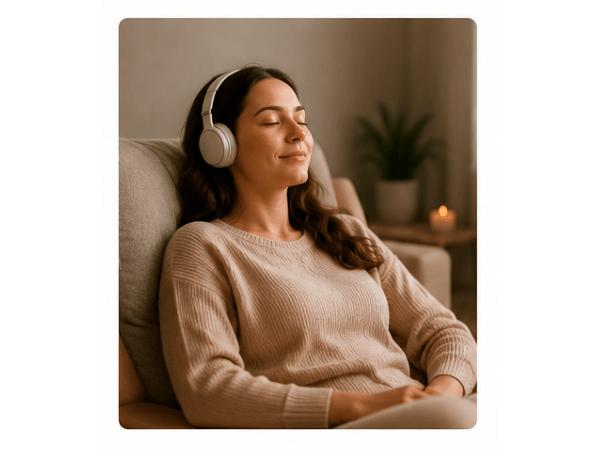
Step-by-Step Procedure for Guided Imagery (Visualization)

1. Find a Quiet Space
Choose a calm, comfortable place where you won’t be disturbed. Dim the lights if possible.

2. Get Comfortable
Sit or lie down in a relaxed position. Close your eyes and take a few deep breaths.

3. Choose or Imagine Your Peaceful Scene
Picture a place where you feel completely safe and at peace. It could be a beach, forest, mountain, or any place that brings you calm.

4. Engage All Five Senses
Imagine the sights, sounds, smells, tastes, and textures of your chosen place. Feel the warmth of the sun, hear the waves, smell the pine, and notice the details around you.

5. Immerse Yourself in the Scene
Allow yourself to be fully present in this place. Let go of worries and focus on the calm and serenity around you.

6. Feel the Relaxation in Your Body
Notice how your body feels as you relax in this peaceful environment. Feel your muscles loosen and your breath stow down.

7. Stay for a Few Minutes
Spend 5—10 minutes enjoying your peaceful place. Return whenever you need a moment of calm.

8. Return to the Present
Take a deep breath. Slowly bring your awareness back to the room. Wiggle your fingers and toes, then gently open your eyes.
3. Loving-Kindness Meditation (Metta)
Sometimes, stress isn’t just about a busy schedule; it’s driven by feelings of frustration, anger, or self-criticism. Loving-kindness meditation focuses on shifting your emotional state.
- How it works: You silently repeat positive, compassionate phrases toward yourself (“May I be happy, may I be safe, may I live with ease”). Gradually, you expand these wishes outward to loved ones, acquaintances, and even people you have conflict with.
- How it helps you relax: Studies show that Metta meditation boosts positive emotions and significantly reduces psychological distress, replacing your body’s stress response with feelings of safety and connection.
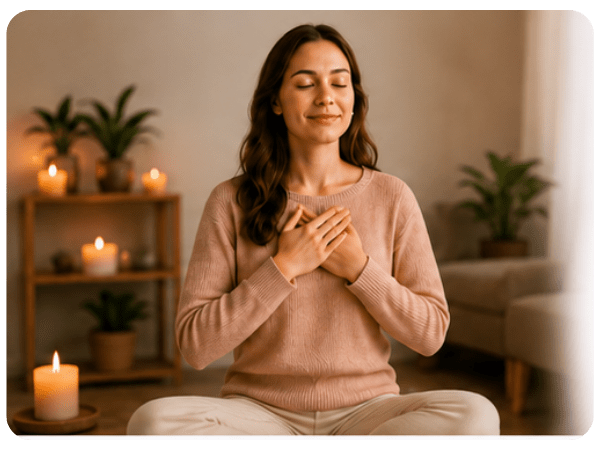
Step-by-step Procedure for Loving-Kindness Meditation (Metta)

1. Find a Quiet Space
Choose a quiet, comfortable place where you can sit without distractions.

2. Settle In and Breathe
Sit comfortably, close your eyes, and take a few deep breaths. Center your mind and body.

3. Focus on Yourself
Bring to mind yourself as you are right now. Begin with phrases of loving-kindness for yourself. ” May I be happy. May I be safe. May I live with ease. May I be Healthy. May I be at peace. “

4. Extend to Someone You Care About
Bring to mind someone you love — family, friend, or partner. Repeat the same phrases for their well-being.

5. Extend to a Neutral Person
Think of someone you don’t know very well — an acquaintance or someone you see but don’t interact with often. Repeat the loving-kindness phrases for them.

6. Extend to Someone You Have Conflict With
Gently bring to mind someone you find difficult. Wish them well with the same phrases. This step is powerful for healing and letting go of negativity.

7. Extend to All Beings
Expand your circle to include all people, all living beings, and the entire world. Repeat: “May All beings be happy. May All beings be Safe. May all beings live with ease. May all beings be at peace.”
8. Close the Practice
Take a deep breath. Notice how you feel. Gently open your eyes and carry this sense of kindness with you into your day.
4. Progressive Muscle Relaxation (PMR)
If stress manifests like a tight jaw, knotted shoulders, or a clenched fist, your body needs a physical pathway to relaxation. PMR bridges the gap between the mind and body.
- How it works: You systematically tense a specific muscle group (like your shoulders) for about 5 seconds, and then consciously release the tension completely. You work your way from your toes all the way up to your face.
- How it helps you relax: PMR creates an immediate, stark contrast between physical tension and physical relaxation. It is incredibly effective for insomnia and winding down before bed.
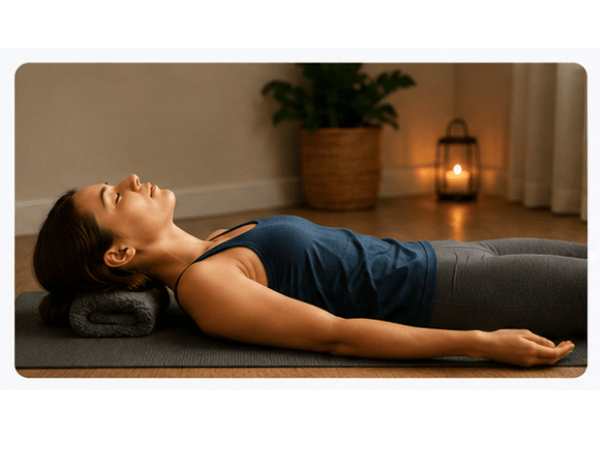
Step-by-step Procedure for Progressive Muscle Relaxation (PMR)

1. Get Comfortable
Lie down or sit in a comfortable position. Close your eyes and take a few deep breaths.

2. Start with Your Toes
Tense your toes by curling them down tightly for 5 seconds. Then, release and notice the relaxation for 10-15 seconds.

3. Move to Your Calves
Tighten your calf muscles by pointing your toes toward your face. Hold for 5 seconds. Release and relax for 10 – 15 seconds.

4. Tense Your Thighs
Tighten your thigh muscles by pressing your legs down. Hold for 5 seconds. Release and relax for 10-15 seconds.
5. Tighten Your Abdomen
Pull your stomach in and tighten your abdominal muscles. Hold for 5 seconds. Release and relax for 10-15 seconds.

6. Squeeze Your Hands
Clench your fists tightly. Hold for 5 seconds. Release and relax for 10-15 seconds.

7. Tense Your Arms
Bend your arms and tighten your biceps. Hold for 5 seconds. Release and relax far 10-15 seconds.

8. Lift Your Shoulders
Shrug your shoulders up toward your ears. Hold for 5 seconds. Release and relax for 10-15 seconds.

9. Relax Your Face
Scrunch your face—tighten your jaw, forehead, and eyes. Hold for 5 seconds. Release and relax for 10-15 seconds.
10. Take a Deep Breath
Altar completing all muse(e groups. take a deep breath in…and slowly exhale. Notice your body feeling heavy and relaxed.
5. Breath Awareness Meditation
The simplest and most accessible form of meditation, breath awareness requires no special tools or apps.
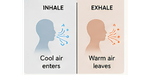
- How it works: You focus entirely on the physical sensation of breathing. You might focus on the rise and fall of your chest, or the cool air entering your nostrils and warm air leaving them.
- How it helps you relax: Deep, rhythmic breathing stimulates the vagus nerve. Stimulating this nerve sends a chemical message through your body to slow down your heart rate and turn off the production of stress hormones.
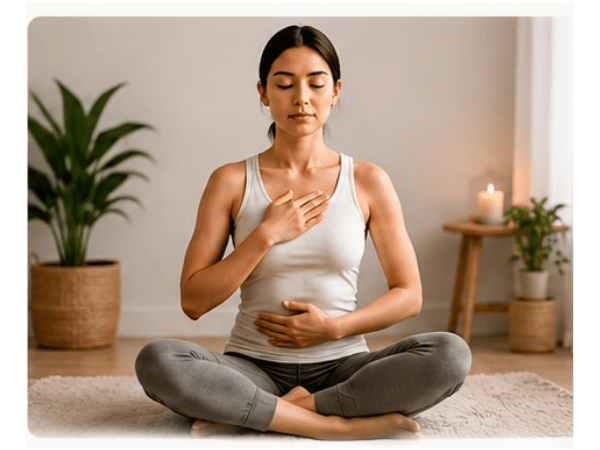
Step-by-step Procedure for Breath Awareness Meditation

1. Find a Quiet Space
Choose a quiet, comfortable place where you won’t be disturbed.
2. Sit Comfortably
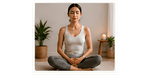
Sit with your back straight but relaxed. You can sit on a clair, cushion, on the floor. Rest your hands on your lap.

3. Close Your Eyes or Lower Your Gaze
Gently close your eyes or look down softly.

4. Bring Your Attention to Your Breath
Notice the natural rhythm of your breath without trying to change it.
5. Focus on the Sensation
Feel the cool air enterirg your nostrils… Feel the rise and fall of your chest and belly… Feel the warm air leaving your body.

6. Notice When Your Mind Wanders
If your mind wanders (which it will), gently notice the thought without judging it.

7. Gently Return to Your Breath
Guide your attention back to the sensation of your breath. This is the heart of the practice.

8. Continue for a Few Minutes
Start with 2-5 minutes and gradually increase to 10-20 minutes as you feel comfortable.
How to Choose the Right Meditation Style for You
Finding your perfect match depends entirely on what your mind and body are craving today:
| If you are feeling… | Try this type: | Why it works: |
| Physically restless or tense | Progressive Muscle Relaxation | Releases physical stress blocks directly. |
| Anxious or trapped in your head | Mindfulness Meditation | Helps you step back from looping thoughts. |
| Impatient with silence | Guided Imagery | Gives your imagination a vivid, calming story to follow. |
| Frustrated or self-critical | Loving-Kindness Meditation | Floods the system with compassion and positive neurochemicals. |
The Golden Rule of Meditation: There is no such thing as “clearing your mind completely.” The magic of meditation isn’t achieving a perfectly blank brain; it’s the exact moment you realize your mind has wandered, and you gently bring it back without judging yourself.
Tips for Beginners: How to Build a Lasting Practice
You don’t need to sit cross-legged on a mountain for an hour to reap the rewards of meditation.
- Start small: Just 2 to 5 minutes a day is enough to begin rewriting your brain’s stress response.
- Be consistent: Meditating at the exact same time every day (like right after you brush your teeth in the morning) helps build a frictionless habit.
- Use technology: Free apps like Insight Timer, or paid options like Headspace and Calm, offer incredible guided tracks that make starting out incredibly easy.
By experimenting with these different types of meditation, you’ll discover the exact tool you need to quiet the noise, lower your cortisol, and find your calm whenever life gets overwhelming.
Recommended Products for Meditation
Disclosure: As an Amazon Associate, I earn from qualifying purchases. We only recommend products that we believe offer value to our readers. Learn more.



Frequently Asked Questions (FAQ)
References
- American Psychological Association. (2023). Mindfulness meditation: A research-proven way to reduce stress. https://www.apa.org/topics/mindfulness/meditation
- Harvard Health Publishing. (2020). Mindfulness meditation may ease anxiety, mental stress. https://www.health.harvard.edu/mind-and-mood/mindfulness-meditation-may-ease-anxiety-mental-stress
- Harvard Gazette. (2011). Eight weeks to a better brain. https://news.harvard.edu/gazette/story/2011/01/eight-weeks-to-a-better-brain/
- National Center for Complementary and Integrative Health. (2021). Meditation and mindfulness: Effectiveness and safety. https://www.nccih.nih.gov/health/meditation-and-mindfulness-effectiveness-and-safety
- National Center for Complementary and Integrative Health. (2023). Meditation: In depth. https://www.nccih.nih.gov/health/meditation-and-mindfulness-what-you-need-to-know
- Goyal, M., Singh, S., Sibinga, E. M. S., et al. (2014). Meditation programs for psychological stress and well-being: A systematic review and meta-analysis. JAMA Internal Medicine, 174(3), 357–368. https://jamanetwork.com/journals/jamainternalmedicine/fullarticle/1809754
- Hölzel, B. K., Carmody, J., Vangel, M., et al. (2011). Mindfulness practice leads to increases in regional brain gray matter density. Psychiatry Research: Neuroimaging, 191(1), 36–43. https://www.sciencedirect.com/science/article/pii/S092549271000288X
- Mayo Clinic Staff. (2024). Meditation: A simple, fast way to reduce stress. https://www.mayoclinic.org/healthy-lifestyle/stress-management/in-depth/meditation/art-20045858
- Cleveland Clinic. (2023). Meditation: What it is, benefits and how to practice. https://health.clevelandclinic.org/meditation
- Mindful. (2023). What is mindfulness? https://www.mindful.org/what-is-mindfulness/