
A scoop of collagen powder takes seconds, while a food-first plan may support your skin in several ways. So, is buying collagen powder or making natural collagen better for radiant skin?
Your body makes collagen from amino acids and nutrients. Collagen powders provide hydrolyzed collagen peptides, not ready-made collagen that travels straight to your skin. Foods such as fish, eggs, beans, fruit, vegetables, and dairy provide materials your body uses to build collagen, along with nutrients that support whole-skin health.
The best choice depends on evidence, cost, convenience, diet, and safety. Collagen powder may give you a steady, measured dose. A varied diet supports collagen production while also providing fiber, antioxidants, healthy fats, and minerals. Neither replaces sunscreen, enough protein, or a steady skincare routine.
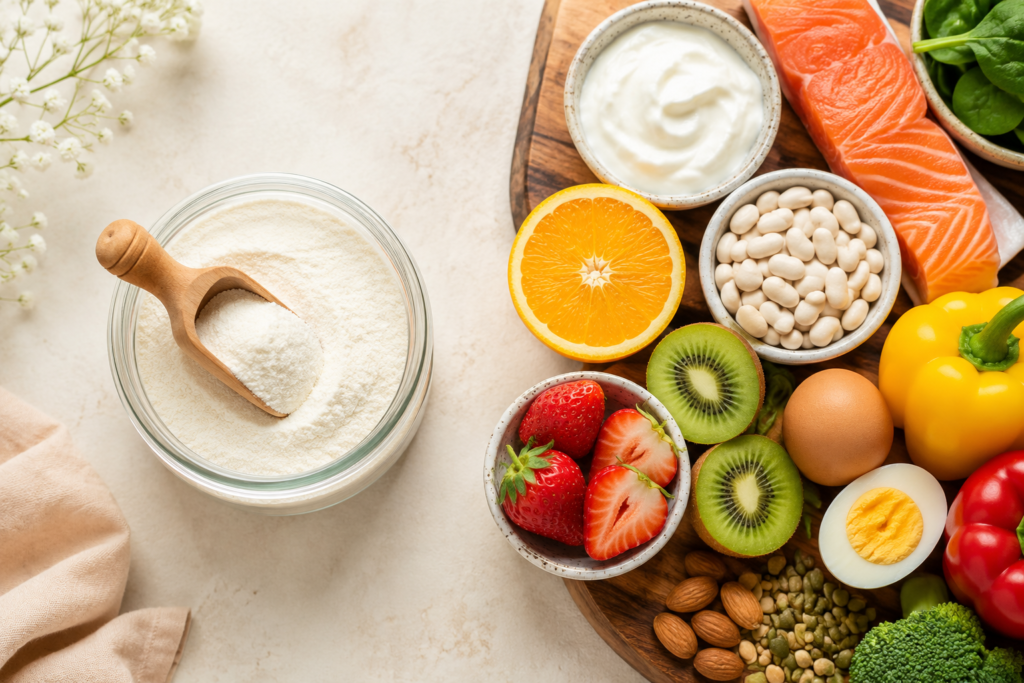
What Natural Collagen and Collagen Powder Actually Provide
Your body makes collagen from protein and key nutrients
Collagen is a structural protein found in skin, bones, cartilage, tendons, and other connective tissue. The body builds it from amino acids, including glycine, proline, and hydroxyproline. Vitamin C is also required for collagen production, according to the National Institutes of Health Office of Dietary Supplements.
Eating collagen does not send intact collagen directly to your face. Digestion breaks collagen-rich foods and supplements into amino acids and small peptides. Your body then uses those materials where they’re needed.
Collagen powder usually contains hydrolyzed peptides
Hydrolyzed collagen has been broken into smaller chains through a process called hydrolysis. These smaller chains are often called collagen peptides or collagen hydrolysate. Gelatin comes from collagen too, but it forms a gel when cooled and isn’t always as easy to mix into drinks.
Powders may contain bovine, porcine, marine, or chicken collagen. The source affects allergies, religious or dietary choices, sustainability concerns, and the type of collagen included.
Food-based support goes beyond collagen-rich meals
Direct collagen sources include fish skin, poultry skin, meat connective tissue, and gelatin. Yet your diet doesn’t need to contain animal collagen for your body to make its own. Protein from fish, poultry, eggs, dairy, soy, beans, and meat supplies the amino acids needed for many body proteins.
Fruits and vegetables add vitamin C and plant compounds. Zinc and copper from foods also support normal body functions linked to tissue health. A varied eating pattern covers more needs than one collagen-focused ingredient.
Buying Collagen Powder May Be Better for Convenience
Research shows possible gains in hydration and elasticity
Studies on oral hydrolyzed collagen have examined skin hydration, elasticity, roughness, and wrinkles. A 2023 systematic review and meta-analysis included 26 randomized trials with 1,721 adults. The studies used doses ranging from about 0.4 to 12 grams daily for two to 12 weeks, and the pooled results showed improvements in hydration and elasticity.
The evidence is mixed, though. A 2025 review in the American Journal of Medicine analyzed 23 trials with 1,474 participants. All studies together showed improvements, but trials without pharmaceutical funding and higher-quality trials did not show a clear benefit. That finding makes collagen powder promising, not proven.
A measured serving is easier to track
Homemade broth may contain collagen, but its amount changes with the bones, connective tissue, water, cooking time, and recipe. A powder label gives you a set serving size and a stated amount of collagen peptides. That makes it easier to compare your routine with the doses used in research.
Check the collagen source, serving size, added sweeteners, flavorings, sodium, and allergen warnings. Products with independent quality testing may offer more confidence about identity and purity. Remember that the FDA does not approve dietary supplements for safety or effectiveness before they reach the market, as explained in its consumer guidance on dietary supplements.
Food-First Eating Supports Collagen and Whole-Skin Health
Protein-rich foods provide collagen-building amino acids
Poultry, fish, eggs, yogurt, milk, tofu, tempeh, lentils, beans, and meat all provide protein. These foods supply amino acids used to make collagen and other important proteins. You don’t need to eat skin or bone broth if you already eat enough varied protein.
A food-first approach may also help if your diet lacks key nutrients. Adding salmon with bell peppers and greens, lentils with tomatoes, or yogurt with berries and seeds supports more than collagen production alone.
Vitamin C foods help normal collagen formation
Citrus fruit, kiwi, strawberries, berries, bell peppers, broccoli, tomatoes, and leafy greens can help you meet your vitamin C needs. The NIH lists a daily recommended amount of 75 milligrams for adult women and 90 milligrams for adult men, with people who smoke needing 35 milligrams more.
Severe vitamin C deficiency can weaken connective tissue and impair wound healing. More vitamin C doesn’t automatically create younger-looking skin, especially when you already get enough. Food also provides water, fiber, and other plant nutrients that a collagen powder may lack.
Homemade Collagen Foods Aren’t Always Better
Bone broth has variable collagen and nutrition
Bone broth can provide gelatin and amino acids, but it isn’t a precise supplement. Preparation changes the result. Bone type, cooking time, acidity, water volume, and the amount of skin or connective tissue all affect the final broth.
A study of homemade and commercial broths found that mineral levels were generally low compared with daily needs, and the researchers noted that preparation methods were difficult to standardize. Broth can also be high in sodium, takes time to prepare, and needs careful cooling and storage. It works as a food, but it shouldn’t be treated as a measured replacement for collagen peptides.
Gelatin works well in recipes
Gelatin is cooked collagen that forms a soft gel when cooled. It can add texture to desserts, soups, and sauces while supplying collagen-related amino acids. It may be less convenient than hydrolyzed peptides in cold water, coffee, or a smoothie.
The research on collagen peptides doesn’t automatically apply to every gelatin recipe. The dose and peptide profile may differ, so homemade gelatin is useful food but not a perfect match for clinical supplements.
The Better Choice Depends on Your Goals
Choose powder when consistency matters
Collagen powder may suit you if you have little time to cook, want a measured serving, or prefer mixing one product into coffee or yogurt. It can also help create a consistent routine for eight to 12 weeks, which matches the length of many studies.
That convenience has value, but it doesn’t guarantee visible results. Choose a product that fits your diet and budget rather than paying more for dramatic claims.
Choose food first when nutrition is the priority
A food-first plan may be better if you prefer minimally processed foods or want to improve your entire diet. Protein-rich meals, colorful produce, healthy fats, and enough fluids support skin along with muscle, bone, and general health.
This approach can also cost less than a daily supplement. You can support collagen production without buying collagen powder.
Combining both is reasonable
You can take collagen peptides while eating protein-rich meals and vitamin C foods. There’s no need to treat the supplement as mandatory or make it the center of every meal. Use it as an optional addition if the cost, ingredients, and routine make sense for you.
Safety and Realistic Expectations Matter
Check allergens and product quality
Marine collagen may be unsuitable for people with fish or shellfish allergies. Bovine, porcine, and chicken products also differ in sourcing and dietary fit. Read the full label for sweeteners, herbs, added vitamins, sodium, and other active ingredients.
Ask for medical guidance when needed
Discuss collagen supplements with a healthcare professional if you’re pregnant, breastfeeding, managing kidney disease, taking medicines, or following a medically restricted diet. Seek care for unexplained rashes, sudden skin changes, poor wound healing, or persistent dryness.
Protect the collagen you already have
Age, genetics, ultraviolet exposure, smoking, sleep, stress, hydration, and skincare habits all affect skin appearance. Daily broad-spectrum sunscreen does more to limit sun-related collagen damage than chasing a new powder. Gentle cleansing, moisturizer, adequate protein, and treatment for skin conditions provide the foundation for a healthy glow.
Conclusion: Powder Wins on Convenience, Food Wins on Range
Collagen powder offers a standardized serving of hydrolyzed peptides and some evidence for improved skin hydration and elasticity. Food-based support supplies protein, vitamin C, minerals, antioxidants, fiber, and healthy fats. Homemade bone broth and gelatin can fit into a balanced diet, but their collagen content varies.
Neither buying collagen powder nor making natural collagen is universally better. Choose powder when convenience and consistency matter most. Choose food first when broad nutrition and a lower-cost plan matter more. Start with varied protein, vitamin C-rich produce, sun protection, and good skincare, then treat collagen powder as an optional extra rather than a radiant-skin requirement.
Recommended Products for Collagen
Disclosure: As an Amazon Associate, I earn from qualifying purchases. We only recommend products that we believe offer value to our readers. Learn more.


Frequently Asked Questions
References
- National Institutes of Health, Office of Dietary Supplements.Vitamin C: Fact Sheet for Health Professionals. Explains vitamin C’s essential role in collagen biosynthesis, recommended daily intake, dietary sources, and vitamin C deficiency. NIH Office of Dietary Supplements – Vitamin C
- Pu, S. Y., Huang, Y. L., Pu, C. M., et al. (2023).Effects of Oral Collagen for Skin Anti-Aging: A Systematic Review and Meta-Analysis. Nutrients, 15(9), 2080. This systematic review analyzed 26 randomized controlled trials involving 1,721 participants. The pooled results found improvements in skin hydration and elasticity with hydrolyzed collagen supplementation, although the authors identified potential biases and called for larger randomized trials. Read the study on PubMed Central
- Myung, S-K., & Park, Y. (2025).Effects of Collagen Supplements on Skin Aging: A Systematic Review and Meta-Analysis of Randomized Controlled Trials.The American Journal of Medicine, 138(9), 1264–1277. This more recent meta-analysis evaluated 23 randomized controlled trials involving 1,474 participants. Although the overall analysis suggested improvements in hydration, elasticity, and wrinkles, benefits were not demonstrated in higher-quality trials or trials without pharmaceutical-company funding. Read the study in The American Journal of Medicine PubMed record
- Aldo, P., et al. (2024).Exploring the Impact of Hydrolyzed Collagen Oral Supplementation on Skin Rejuvenation: A Systematic Review and Meta-Analysis. This review evaluated randomized controlled studies of hydrolyzed collagen and reported favorable pooled findings for skin moisture and elasticity, while adding to the broader—and still evolving—evidence base on collagen supplementation. Read the study on PubMed Central
- U.S. Food and Drug Administration.Is It Really “FDA Approved”? The FDA explains that dietary supplements are not FDA-approved for safety and effectiveness before being marketed. Manufacturers are responsible for ensuring that their supplements are safe and meet applicable labeling and quality requirements. FDA – Dietary Supplement Regulation and Approval
- Hsu, D. J., Lee, C. W., Tsai, W. C., & Chien, Y. C. (2017).Essential and Toxic Metals in Animal Bone Broths.Food & Nutrition Research, 61(1), 1347478. This study analyzed essential and toxic metals in animal bone broths and is useful background for discussing the nutritional contribution and safety considerations of bone broth. Read the Bone Broth Study
- National Institutes of Health, Office of Dietary Supplements.Vitamin C: Fact Sheet for Consumers. Provides consumer-friendly information on vitamin C, including its role in collagen production and recommended daily intake. The NIH lists 90 mg per day for adult men and 75 mg for adult women, with an additional 35 mg recommended for people who smoke. NIH – Vitamin C Consumer Fact Sheet